Mrs Goodbody
Hallowe'en PartyMrs Goodbody is the genial local woman who plays a witch in village pageants and tells fortunes. Though her appearance readily fits the part, her most consequential contribution to Hercule Poirot’s investigation is not supernatural: an old nursery rhyme she associates with the missing Olga Seminoff points him towards the well where her body was concealed.
The Village Witch
Poirot finds Mrs Goodbody’s face an almost perfect model for a witch’s, but the illusion is softened by her extreme amiability. She speaks with relish and pleasure, and explains that she regularly plays the witches in local performances. The vicar praised her work in the previous year’s pageant and promised her a new steeple hat, since a witch’s hat wears out like anything else.
Her part extends beyond the costume. Mrs Goodbody makes rhymes using the girls’ Christian names and gives them to whoever performs the spirit voice, who recites them to the young people at the mirror. Nicholas Ransom and Desmond Holland contribute fake photographs, which they float down as part of the entertainment. She laughs at the boys’ disguises and enjoys their colourful clothes, comparing them to kingfishers, peacocks, and birds of paradise; in contrast, she teases the girls for concentrating on skirts and the layers worn beneath them. Her fondness for vivid historical dress gives her account a humorous, observant tone rather than the menace suggested by her witch’s appearance.
Fortune-Telling and Local Knowledge
Mrs Goodbody tells fortunes, although she treats the practice as harmless. She says the police dislike it, but that there is little to it: in a place like Woodleigh Common, she can often tell who is going out with whom. Her remarks locate her within the everyday circulation of village gossip, where observation and familiarity can pass for occult insight.
When Poirot asks whether she can use her ball to see who killed Joyce Reynolds, she corrects him: it is a crystal ball, not a witch’s ball. She declines to name the person she suspects, saying Poirot would dislike the answer and call it against nature; she adds that many things happen against nature. The exchange does not establish that she knows the killer’s identity. Instead, it shows her withholding a suspicion while hinting that the case may involve something disturbing or unnatural.
The Rhyme and the Well
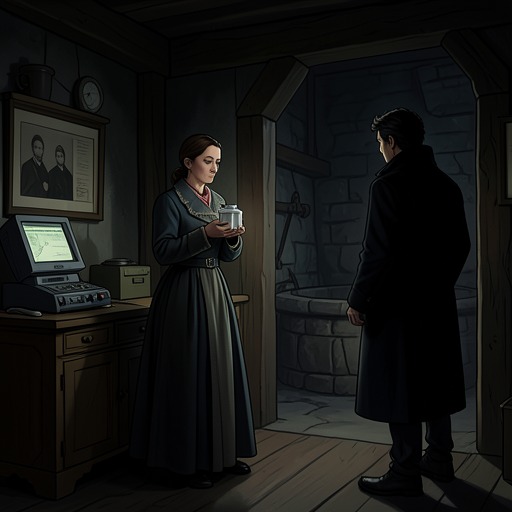
Asked what became of the foreign girl said to have run away, Mrs Goodbody doubts that she went far and recalls the rhyme, "Ding dong dell, pussy's in the well." She offers it as her own long-held thought, not as a claim to have seen what happened. At the time, the remark sounds like local intuition; its importance becomes clear when Poirot later recalls it while considering where Olga Seminoff might have disappeared.
Poirot had already wondered whether Olga’s body was hidden somewhere nearby, but did not know where. He had also heard Miranda Butler ask Michael Garfield to take her to a wishing well, and Garfield refuse. Mrs Goodbody’s rhyme connects the missing girl with that otherwise unexplained well. Poirot follows the clue to a well in Quarry Wood, on an incline not far from Garfield’s cottage, where Olga’s body had been concealed. The rhyme therefore works not as proof of supernatural knowledge but as a fragment of local speech that helps complete the investigators’ chain of inference.
Role in the Investigation
Mrs Goodbody tells Poirot that she cannot help him, but he replies that she has helped a great deal. The gap between her modest view of her usefulness and the importance of the rhyme gives her scene its investigative force: she supplies no confession, identification, or direct account of the crime, yet her casual association of the missing woman with a well gives Poirot a decisive direction to pursue. Her role joins village performance, gossip, and nursery-rhyme tradition to the practical work of solving the case.